
A Call for School Board Transparency Pt. 2
Best Practice and Legal Standards for Meeting Minutes

Read Part 1: An Update and A Call for Board Transparency

Part 2: Best Practice and Legal Standards for Meeting Minutes
While Idaho’s Open Meeting Law doesn’t hold governing boards to a high standard, courts and open-government authorities in multiple states have made clear that minutes must be detailed enough for the public to understand what happened and why decisions were made. For example:
The Massachusetts Attorney General’s Office, in its official Open Meeting Law Guide, states plainly: “Minutes must include a substantive summary of the discussion on each topic.” It further requires that “minutes should contain enough detail and accuracy so that a member of the public who did not attend the meeting could read the minutes and have a clear understanding of what occurred.” Massachusetts Open Meeting Law Guide, 2025 (PDF) - https://www.mass.gov/doc/open-meeting-law-guide-2025/download
Likewise, North Carolina law requires even closed-session minutes to “keep a general account … so that a person not in attendance would have a reasonable understanding of what transpired” (N.C. Gen. Stat. § 143-318.10(e)). NC General Statutes Online - https://www.ncleg.gov/EnactedLegislation/Statutes/PDF/BySection/Chapter_143/GS_143-318.10.pdf
The Reporters Committee for Freedom of the Press (RCFP) highlights this principle in its Open Government Guide, quoting the Ohio rule: “sufficient facts and information to permit the public to understand and appreciate the rationale.” RCFP Open Government Guide – Ohio https://www.rcfp.org/open-government-guide/ohio/
The National Freedom of Information Coalition (NFOIC) likewise stresses that “meeting minutes should tell the story of the meeting in a way that lets the public know not only what was decided but why.” NFOIC Best Practices
Washington State Auditor’s Office. (2018). Open Public Meetings Act Best Practices Guide. Olympia, WA. Supplement “action” minutes with recordings, if available. If the agency records the meeting, the recording can be made available to the public along with the action minutes for the benefit of those who desire more detail. https://sao.wa.gov/sites/default/files/2023-11/OPMA-Minutes-Practice-Tips-23.pdf
New York State Committee on Open Government. (2016). Advisory Opinions on Open Meetings Law. Albany, NY. “In my view, above all, minutes are intended to be the official, permanent record of actions taken by public bodies. Their accuracy and completeness are necessary to enable the public to know of public bodies' activities. Equally important, minutes constitute a history of activities upon which public bodies may rely historically, in both the long and short terms, and public bodies often have a need to know of actions they have taken”. https://docsopengovernment.dos.ny.gov/coog/otext/o2192.htm
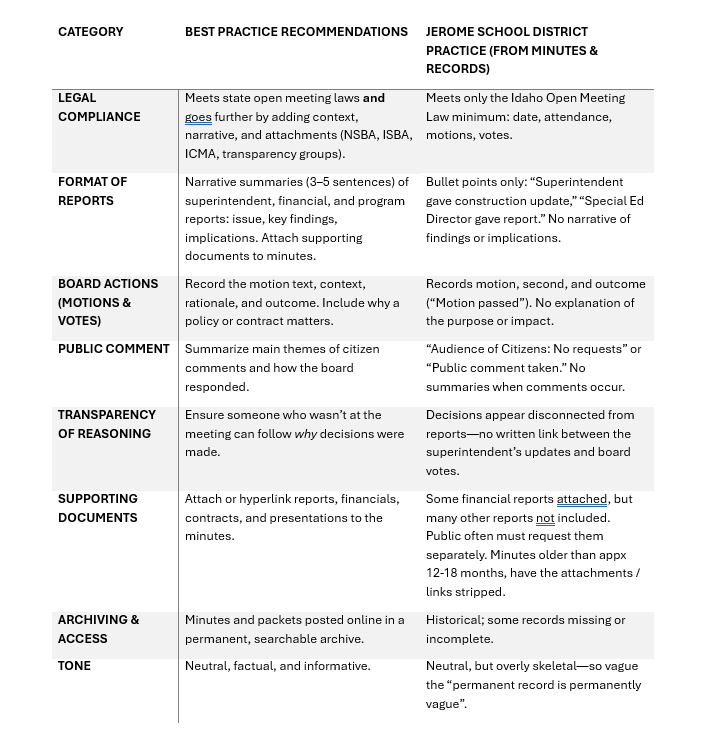
Jerome’s current practice, bullet points with no narrative, deliberately withholds the reasoning that matters most. Parents cannot see why decisions were made, why funds were spent, or what risks were acknowledged. When minutes are this thin, and when attachments are inconsistent, restricted, missing, or later removed altogether, the board satisfies the letter of the law while undermining the spirit of transparency. Community members are left guessing at what happened, or chasing down attachments and records through formal requests. The record exists, but it does not inform.
If Jerome wants to rebuild trust after the transportation crisis, one place to start is the minutes. The district should adopt best practices: narrative summaries of reports, clear explanations for motions, consistent reporting standards across departments, and full attachments posted online. Transparency is not served by bare legality; it is served by candor, clarity, and records that tell the truth of what happened in the boardroom.
Call to Action: Legislative and Local
This failure is not inevitable. Both lawmakers and local trustees have the power to change course.
Legislative Action:
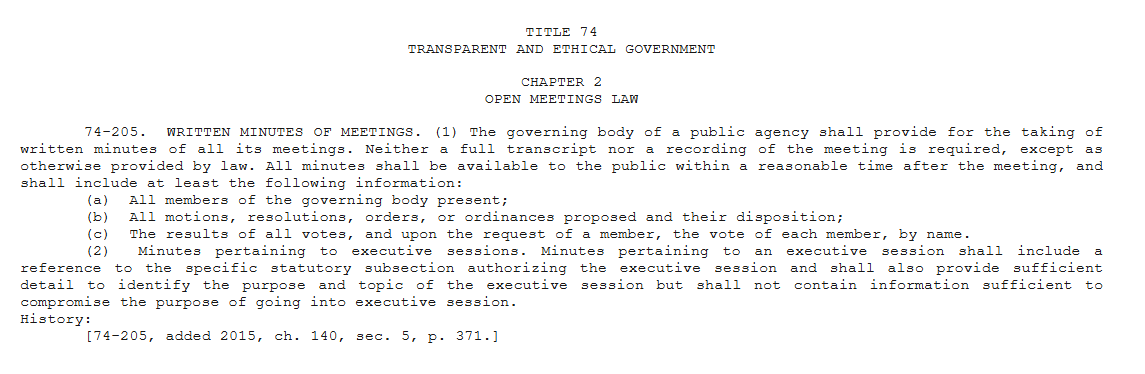
Idaho lawmakers should strengthen the Open Meeting Law (I.C. TITLE 74 Chapter 2) to require narrative summaries of reports, contextual explanations of board actions, and permanent online access to complete minutes and attachments. Other states, including Massachusetts, North Carolina, New York, and Washington, already demand more detail or publish clear best-practice guidance. Idaho should do the same. A statutory change clarifying that minutes must allow the public to “understand what happened and why decisions were made” would close the gap that Jerome has abused.
Local Action:
Citizens cannot wait for Boise to act. Trustees can immediately adopt a local policy requiring consistent reporting standards, narrative minutes with summaries of reports, and permanent online posting of all supporting documents. Parents and residents should attend board meetings, file records requests, and demand that the board adopt these standards now. Transparency does not require new legislation. It requires will.
Public trust in schools depends on records that inform, not records that obscure. It is time to demand candor in the minutes, clarity in the record, and accountability in leadership.
Disclaimer
This article is public commentary offered under the protections of the First Amendment. It reflects the author’s analysis, opinions, and interpretations based on publicly available records, news reports, and official communications. Nothing in this article should be taken as legal advice or as a definitive statement of fact beyond the cited sources. Readers are encouraged to consult original documents and reach their own conclusions. Any errors will be corrected if brought to the author’s attention.