
When the Doors Close: Jerome County’s Executive Session Problem
Is Jerome County Violating Idaho' s Open Meeting Law

When the Doors Close: Jerome County’s Executive Session Problem
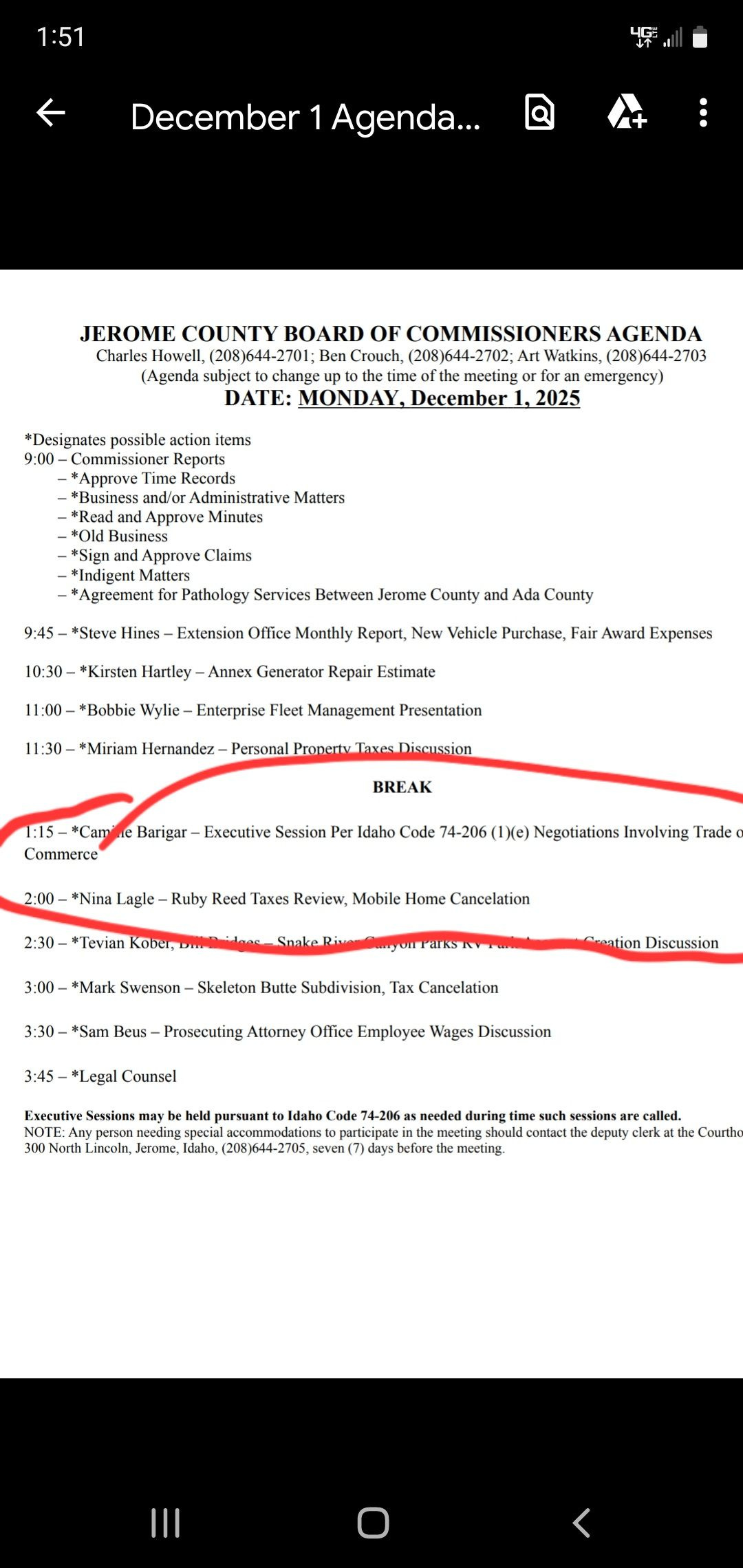
On December 1, 2025, the Jerome County Board of Commissioners posted an agenda item that should concern every citizen who believes county government belongs to the public.
At 1:15 p.m., the agenda called for Cammie Barigar, Executive Director of the Jerome 20/20 Economic Development Organization, to lead the commissioners into executive session under Idaho Code § 74-206(1)(e): “Negotiations Involving Trade or Commerce.”
On its face, the citation looks official. The subsection exists. But the question isn’t whether they cited a real statute. The question is whether the statute means what they think it means, or what they want it to mean.
It doesn’t.
What the Law Actually Says
Idaho Code § 74-206(1)(e) permits executive session to consider “preliminary negotiations involving matters of trade or commerce in which the governing body is in competition with governing bodies in other states or nations.”
Three elements must all be satisfied. First, the negotiations must be “preliminary.” Second, the subject must involve actual matters of trade or commerce. Third, and this is where Jerome County’s use collapses, the governing body itself must be in competition with governing bodies in other states or nations.
Not a private economic development organization. Not a business prospect shopping for locations. The governing body.
The Legal Problem
A county commission is not a market participant.
It does not compete.
It governs.
Its role in economic development is regulatory and administrative: zoning, permitting, tax policy, infrastructure. Jerome 20/20 is the entity that recruits businesses and negotiates with prospects.
It is a separate organization funded by a mix of public and private partners. Whatever competition exists for a business prospect is between Jerome 20/20 and economic development organizations in other states, not between the Jerome County Board of Commissioners and the governing bodies of other states or nations.
If the discussion behind those closed doors involved county permits, zoning approvals, tax treatment, or infrastructure commitments, those are governmental actions governed by established code and statutory criteria under the Local Land Use Planning Act (Idaho Code §§ 67-6501 et seq.) and Idaho tax law. A conditional use permit has criteria. A tax exemption has criteria. You either meet them or you don’t. There is nothing to “negotiate” in a competitive sense, and the county cannot offer special deals behind closed doors that it would not offer through normal public process.
The Idaho Attorney General’s Open Meeting Law Manual is explicit on this point: the statute “specifically directs that the exceptions be construed narrowly“ and warns that “no entity should try to ‘shoehorn’ an issue into an executive session exception.“ The Idaho Association of Counties trains commissioners on this same principle.
In its Open Meeting Law presentations, IAC materials state that executive session exceptions “shall be narrowly construed“ and remind county officials that members of commissions, committees, and boards “may be penalized personally“ for violations. The IAC’s own best practices presentation by Louis Marshall noted there was “no case law guidance” on the trade or commerce exception at the time of that training, meaning commissioners were relying on an untested provision with no judicial backing for their interpretation.
That changed in December 2024.
The Labrador Decision
In Labrador v. Idaho State Board of Education (Idaho Supreme Court, Docket No. 51580, December 16, 2024), Attorney General Raúl Labrador sued the State Board of Education for using § 74-206(1)(e) executive sessions to secretly negotiate the University of Idaho’s $550 million purchase of the University of Phoenix. The district court upheld the Board’s executive sessions under a broad reading of the statute. The Idaho Supreme Court reversed.
The Supreme Court found that the district court erred in its expansive interpretation of both “preliminary negotiations” and “is in competition with,” holding that these phrases provide only narrow exceptions to the general policy of transparency. The Court reaffirmed that the Idaho Open Meetings Law begins with the declaration that “the people of the state of Idaho in creating the instruments of government that serve them, do not yield their sovereignty to the agencies so created” and that “the formation of public policy is public business and shall not be conducted in secret.”
The Court also held that there must be an actual state of competition between governing bodies, not merely a belief that competition exists.
Consider what this means for Jerome County. The State Board of Education had a far stronger argument for competition than the Jerome County Commission does. The Board was literally bidding against the University of Arkansas system to acquire the same institution in a direct purchase transaction. And the Supreme Court still reversed. Jerome County commissioners receiving a briefing from a private economic development director about a business prospect does not come close to meeting this standard.
What If It Was a Contract With Jerome 20/20?
Some might suggest the executive session involved negotiating a contract between the county and Jerome 20/20 itself — a funding agreement, a services contract, or a memorandum of understanding for economic development services. That still doesn’t work under (1)(e).
The county is not “in competition with governing bodies in other states or nations” to hire its own local economic development organization. Nobody in Nevada is bidding against Jerome County to contract with Jerome 20/20. There is no interstate competitive interest to protect because there is no interstate competition.
If anything, a contract between the county and Jerome 20/20 is even more clearly public business. That is taxpayer money going to a third-party organization. The public has every right to see the terms, the scope of work, the deliverables, and the cost.
The only other executive session subsections that could conceivably apply would be (1)(c), acquiring an interest in real property not owned by a public agency, but only if the contract involved a land transaction, or (1)(f), communicating with legal counsel about pending or imminent litigation between the county and Jerome 20/20, which would be a different situation entirely. Neither was cited.
A service contract with a local economic development nonprofit does not satisfy (1)(e) no matter how you stretch it. Either Barigar was bringing a business prospect to the commissioners and they used (1)(e) as cover to discuss it privately, or the discussion involved a county-to-Jerome 20/20 contract that had no business being in executive session at all. Either way, the doors should have stayed open.
The Ethical Problem
The legal analysis matters. But the ethical dimension matters more, because it speaks to the kind of county government Jerome’s citizens deserve.
Idaho Code § 74-201 declares that the formation of public policy is public business. This is not a suggestion. It is a foundational statement about the relationship between citizens and the government they created. When county commissioners close the doors to hear about economic development projects that will affect land use, water, power, infrastructure, and the character of the community, they are forming public policy in secret. The fact that a private organization facilitates the discussion does not change the nature of the decisions being made.
Jerome County is in the middle of a generational debate about its future. Data centers, battery energy storage systems, transmission infrastructure, and industrial-scale energy projects are converging on the Magic Valley. These projects will determine whether Jerome County remains an agricultural community or becomes an industrial energy corridor. The people who live here, who farm here, who raise families here, have an absolute right to know what is being discussed and decided on their behalf.
Using executive session to shield economic development discussions from public scrutiny is not just a technical legal violation. It is a breach of the social contract between a governing body and its citizens. Every time the doors close on a discussion that will shape the future of the county, the public loses its ability to participate, to object, to offer alternatives, or to hold its elected officials accountable.
The Idaho Association of Counties’ own training materials acknowledge this tension. Seth Grigg, IAC Executive Director, has presented to county officials that a public meeting is “the convening of a governing body of a public agency to make a decision or deliberate toward a decision.” If commissioners are deliberating toward a decision about whether to support, incentivize, or accommodate an economic development prospect, that is a public meeting. Full stop.
What Citizens Should Demand
First, the minutes from the December 1, 2025, executive session should reflect whether a proper two-thirds roll call vote was taken to enter executive session, as required by § 74-206(1). If the procedural requirements were not met, the session is void on its face.
Second, citizens should ask the commissioners to explain, specifically, how the Jerome County Board of Commissioners was itself “in competition with governing bodies in other states or nations.” Not how Jerome 20/20 was competing. Not how a business prospect was comparing locations. How the governing body of Jerome County was a competitive party in a matter of trade or commerce.
Third, if any action, deliberation, or decision-making that led to subsequent county action occurred during that executive session, citizens are entitled to bring a lawsuit in magistrates’ division to require compliance and to ask the court to declare any improper actions void, per Idaho Code § 74-208.
Fourth, going forward, the Board of Commissioners should adopt a standing policy that economic development briefings from Jerome 20/20 are conducted in open session unless the county’s own legal counsel can certify in writing that every element of § 74-206(1)(e) is satisfied under the narrow construction standard established by the Idaho Supreme Court in Labrador.
The people of Jerome County did not yield their sovereignty to the agencies they created. When the doors close on public business, sovereignty walks out of the room. It is time to bring it back in.
References:
Idaho Code § 74-201 (Declaration of Policy)
Idaho Code § 74-206(1)(e) (Executive Sessions — Trade or Commerce Exception)
Idaho Code § 74-206(2) (Narrow Construction Requirement)
Idaho Code § 74-208 (Violations and Enforcement)
Idaho Code §§ 67-6501 et seq. (Local Land Use Planning Act)
Labrador v. Idaho State Board of Education, Idaho Supreme Court, Docket No. 51580 (December 16, 2024)
Idaho Attorney General, Open Meeting Law Manual (August 2025 edition), available at ag.idaho.gov
Idaho Association of Counties, “Open Meeting Best Practices” presentation by Louis Marshall (2025), available at idcounties.org
Idaho Association of Counties, “Open Meetings — Advanced Session” training by Brian V. Church, Office of the Attorney General (March 2023), available at idcounties.org
Idaho Association of Counties, “Idaho Open Meeting Law” presentation by Seth Grigg, Executive Director, available at idcounties.org