The High Table and The Altar
A Critical Examination of Imagery, Theology, and Political Mysticism in a Contemporary Song of Warning

“For we wrestle not against flesh and blood, but against principalities,
against powers, against the rulers of the darkness of this world,
against spiritual wickedness in high places.”
— Ephesians 6:12 (King James Version)
Explaining the Meaning of “The High Table and The Altar”
When I wrote this song, I was trying to explore an idea that appears throughout scripture and history. The most dangerous forces shaping the world are often not visible. They are not always armies, criminals, or enemies standing directly in front of us. Many times the real forces shaping events operate through systems, institutions, traditions, and loyalties that most people never see.
The origins of the song
Bone and Marrow - Where The Song Started
The opening lines of the song set that frame.
“This is not the enemy you can see. This is not the enemy you can name.”
That idea comes directly from the biblical concept that the deepest struggles of human history are not merely physical. They involve powers, ideologies, and structures that influence human behavior and decision making. The language of “principalities” and “powers” is not meant to describe monsters or supernatural villains in a dramatic sense. It refers to authority structures and forces that shape the actions of people and nations.
I wanted the listener to think about power in that broader sense.
The Tabernacle of Kings
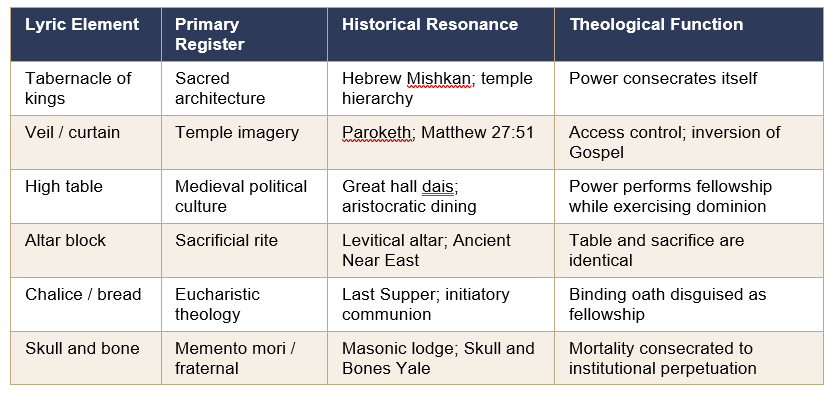
The first image in the song is the “tabernacle of kings.” In scripture the tabernacle was the place where God dwelled among His people. It was sacred space. In the song I intentionally applied that language to political authority. Throughout history power often clothes itself in sacred symbolism. Crowns, ceremonies, oaths, robes, and rituals all create the impression that authority is ancient, legitimate, and almost holy.
The imagery of curtains, oil, and consecrated dust is meant to evoke the atmosphere of old temples and coronation halls. These places carry the weight of tradition. They feel timeless. Yet inside those rooms decisions are made that shape the lives of millions of people who will never see the process.
That is why the verse ends with a line about a feast that no one has been told about. It is a metaphor for decisions that happen quietly behind closed doors.
The Table Behind the Veil
The central symbol in the song is the table behind the veil.
A table is normally a place of fellowship and agreement. People share bread together to signal trust or alliance. But the song places a blade next to the bread and turns the table into something closer to an altar.
This combination is intentional. It represents the reality that agreements made in rooms of power often determine who prospers and who pays the cost. The people sitting at the table are not always the ones who will experience the consequences of those decisions.
So the table becomes both a place of covenant and a place of sacrifice.
The refrain “This is the power. This is the throne” is meant to emphasize that this quiet setting is where authority actually operates.
Ritual and Oath
Several verses describe gestures that resemble ancient rituals. Linen cloth, cups, bows, lifted hands, and shared drink all appear throughout the song.
In ancient cultures those gestures sealed loyalty and covenant. Agreements were not always written contracts. They were symbolic acts performed in front of witnesses. Once someone participated in the ritual, they were bound to the system it represented.
The line about the cup touching the lip and the stain of crimson is meant to represent a binding oath. It does not need to be shouted or declared publicly. It is sealed quietly within a tradition.
That imagery reflects the way power structures often rely on loyalty, networks, and shared commitments that are never formally announced.
The Bones Beneath the Floor
Later in the song there is a darker image describing skulls and bones beneath the planks of the hall.
This image represents history. Rulers come and go. Empires rise and fall. But the institutions and systems they build often remain long after they are gone.
The bones symbolize generations of authority layered beneath the present moment. The phrase about hollow chambers turning to policy suggests that modern decisions are often shaped by inherited doctrines and traditions that have accumulated over centuries.
In other words, power has memory.
The World Outside the Hall
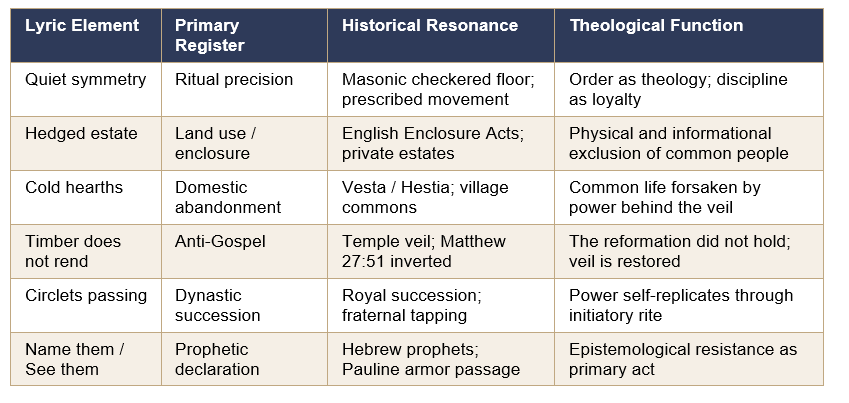
While the rulers gather behind the veil, the song shifts briefly to the world outside. The hearths of ordinary homes grow cold and the daily bread of common families goes unblessed.
This contrast is important. The song is not only about hidden authority. It is about the distance that can grow between decision makers and the people affected by those decisions.
The people outside the estate may never see the table where choices are made, yet their lives are shaped by what happens there.
The War No One Sees
Near the end of the song the spoken section explains the theme directly. The war described in the song is not fought with swords in open fields. It is fought through institutions, loyalties, traditions, and silent agreements.
Leaders come and go. Crowns pass from one head to another. But the structure of power continues.
That is what the line “the war the waking world unlearns” is meant to suggest. Modern societies often forget how much influence is exercised through systems rather than visible battles.
The Final Message
The final verse brings the symbols together by joining the table and the altar into the same piece of wood. The place where agreements are made becomes the place where sacrifices occur.
The closing declaration returns to the idea that inspired the song in the first place. The struggle is not only against individuals. It is against the forces and systems that influence them.
The final lines are meant as a challenge rather than a conclusion.
Name them.
See them.
Stand.
The purpose of the song is not simply to describe hidden power. It is to encourage people to become aware of it and to think carefully about the structures that shape the world around them.
Imagery, Sources, and Resonances