
How Do Idaho's Counties Stack Up?
A side-by-side look at how seven Idaho counties are handling the energy development question — and who's getting it right.

Jerome County’s (Jerome County Idaho) current energy ordinances are an F-, a complete fail. They are in limbo and do not even begin to address data centers or the economic crisis brought on by the potential loss of prime farmland. A recently submitted, citizen’s ordinance reform package can change that.
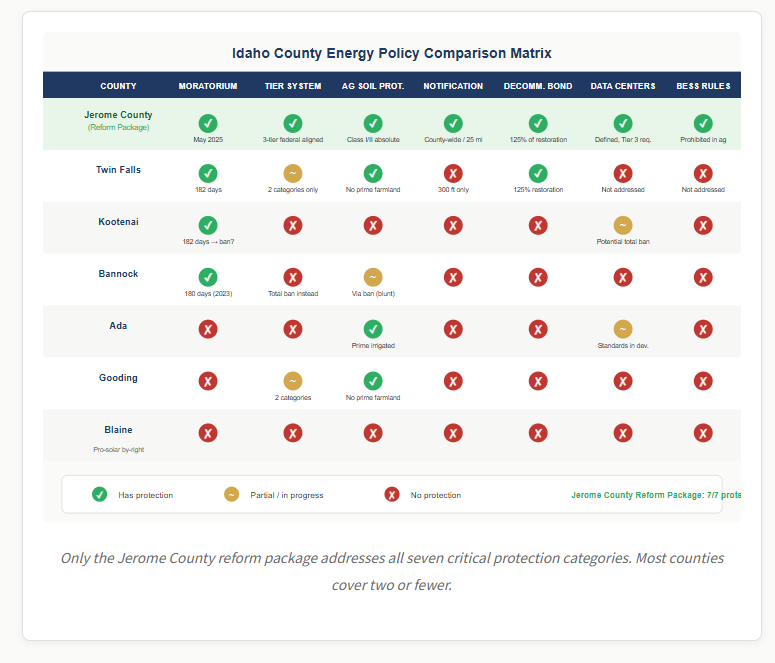
If you think your county has a plan for energy development, you might want to check. Across Idaho, the regulatory response to the data center boom and industrial energy expansion ranges from comprehensive reform proposals to complete silence. Some counties have imposed moratoriums. One enacted a total ban. Others have done nothing at all. Here's how seven counties compare on the protections that matter most.
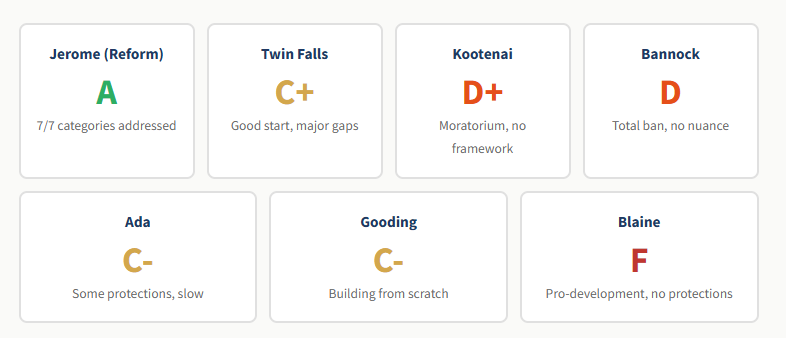
The Report Card
Assuming Jerome County adopts the ordinance reform package, Jerome County may have the strongest, most complete package in the state. Short of a total ban, the package may provide more protection for farmland and the counties economic welfare than any other ordinance.
What Stands Out
Notification: The Great Failure
Not a single Idaho county — not one — currently requires county-wide notification for large energy projects. Twin Falls County’s draft ordinance requires notification within 300 feet. That’s roughly the length of a football field. A utility-scale solar farm’s visual, noise, and traffic impacts extend for miles. A data center’s water and power impacts are county-wide. The reform package’s proposal of county-wide or 25-mile notification (whichever is greater) for all Tier 2 and Tier 3 projects is the only approach that matches the scale of the impact to the scale of the notification.
Data Centers: The Blind Spot
Only Ada County and the Jerome County reform package specifically address data center facilities. Every other county treats them like any other commercial or industrial use — if they address them at all. Given that a single data center can consume more water than a small city and more electricity than an entire county’s existing load, this regulatory blind spot is staggering.
The Ban vs. The Framework
Bannock County’s total ban on large-scale solar and wind projects is the most dramatic response of any Idaho county. But it’s also the least useful as a policy model because it offers no tiered approach — it blocks the projects that 49.2% of Jerome County residents actually support (small-scale) alongside the ones that 93.7% oppose (large-scale on ag land). A framework that distinguishes between project scales is more durable, more defensible legally, and more responsive to what communities actually want.
“The question isn’t whether to allow energy development. It’s whether to allow energy development without rules, without notification, without bonds, and without the consent of the people who live here.”
The takeaway for every Idaho county: If your ordinance doesn't define energy tiers, protect Class I/II soils, require county-wide notification, mandate decommissioning bonds, and specifically address data centers and battery storage — you have gaps. The Jerome County reform package is a blueprint for filling them.
Send this to your commissioners and legislators, let them know what you think!